I’m weaving “jakaku sisan”, that is, an Andean weaving pattern with a pickup technique, worked on 16 pattern threads, which takes a basic narrow pattern and doubles it. The doubled pattern is also rotated in this case, so that the two sets of pattern move in opposite directions (I say move because it looks like a wave, and I feel a movement in the direction toward the spiral part.) What mesmerizes me about this pattern, though, is the completeness of the intertwining, the way the shapes made by the contrasting colors cannot be separated. Particularly in the simple band, the width of one unit of the pattern - the two colors are identical interlocking shapes. The doubled pattern introduces another shape formed by the rotation, but it still feels utterly inseparable to my eyes and mind. What I mean is that this mind which is trained to see ‘figure and ground,’ which tends to interpret many Andean patterns that way, even though that’s not how they’re seen within the weaving culture - that mind is overridden or bypassed by this pattern. It sneaks behind my consciousness and says “look, there’s no shape + background, it’s all just one, integrated thing.” This pattern has always been compelling to me for this reason.
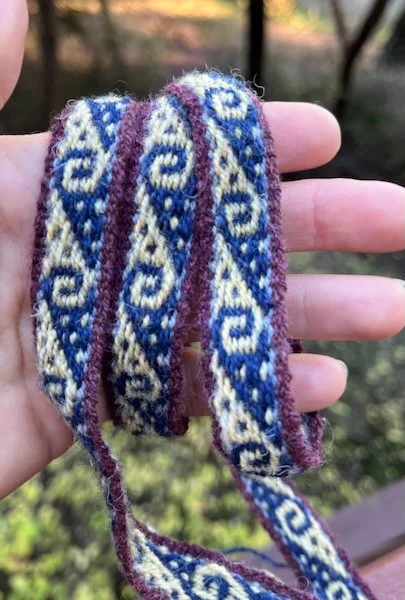
The basic curl (sakas) pattern, woven recently with spindle-spun wool
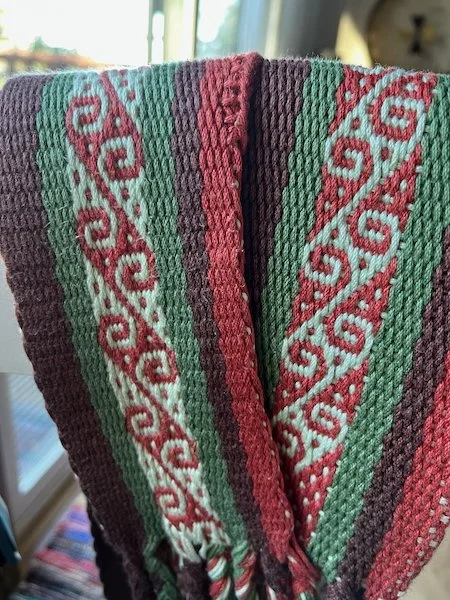
Jakaku sisan, woven more than ten years ago (YouTube link to a former self) using a chart, with Tahki Cotton Classic yarn. This is one band, folded and stitched to make a backstrap - the pattern is the same with colors reversed on the back. Here’s a closer video, although the quality is not great.
In a teaching packet from a weaving workshop, Abby Franquemont describes the pattern like this:
A jakaku is a bird, like a hummingbird. They like to go for the sisan part of the flower, and for flowers where you see the sisan. It has curly bits. And a jakaku will stick its beak right in there.
Which I may have seen before, since the workshop was in 2018, but I did not read or really take in this bit until recently. Like a mystic poem or a koan, it struck me just when I was ready, ringing loud with gleeful resonance. The bird and the flower, interlinked and reciprocal - yes, the pattern says just that! And not just bird & bees & flowers, but this highly evolved, very particular type of bird, the hummingbird with the long beak and long tongue and the flowers that court this bird’s attention with their complex shapes and curls.
It makes me think of the astounding specificity of adaptation, how it’s almost an act of love, how a creature so intricately responds, over time, to a plant and vice versa. How one organism reveals itself to be part of The Organism, this wholeness, in its intimate adaptation to a particular curve of shape or attitude of presentation… Like dancers who bow to one another, implicitly saying I know we are different and that I will make minute adjustments to fit myself to you for this movement… we belong together but we do not exactly match, and so I will be alert and responsive to our interactive shape, brining enough of myself to enhance the sum - the sum of our meeting, which uplifts and exceeds each of us. This dance, continuous in the extended, fractal details of nature, giving promise or potential to each mutation, each irregularity a possibility for transformation into something “fitter”, that is to say more suited, more at home where it lives.
So yeah - that image took off for me, and fits precisely with the wholeness of my perception of the design, the inability to separate the interlocked shapes. This is how the world works: all together.
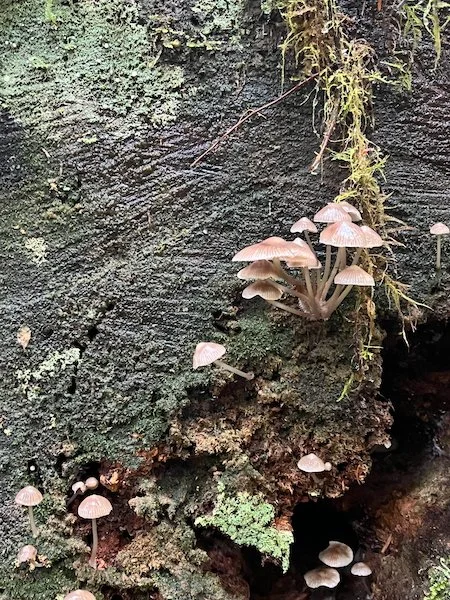
Although I have close relations with hummingbirds these days, I don’t have photos. I was thinking forest stump life demonstrates a similar level of reciprocal co-evolution and intertwined existence.
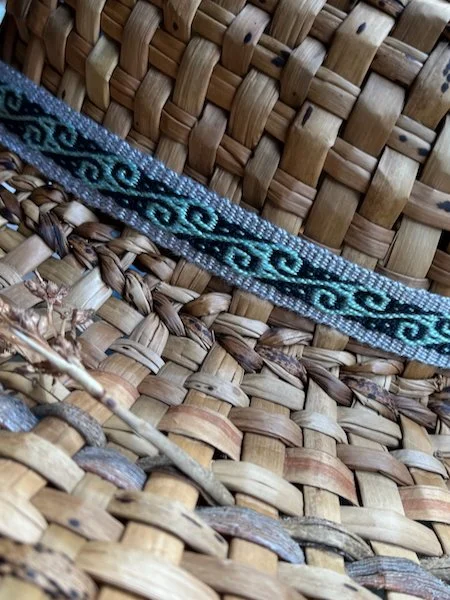
Jakaku sisan band, woven recently with #10 crochet cotton, without using a chart, shown as a band on my handwoven bullrush hat.
It’s like going from writing to storytelling or singing, the difference between weaving from a chart and knowing the pattern by heart. I knew when I first started that this was an essential step in weaving Andean pickup, and traditional techniques from other cultures as well. The weaving is learned with the hands in communication with the heart/mind, and while using a chart helps us make the correct designs appear in our weaving, it does not give us the same kind of learning. This understanding made me resistant to charts, but I also didn’t have the patience to weave dozens of bands with the basic patterns again and again. I am a reader and a writer and, by my placement in the world and time, a dabbler in weaving rather than an integral element of a living tradition. No one is relying on me to weave a thing so they can use it, to learn the patterns of my village or clan or lineage correctly so that I can represent us with skill and pride in the clothing I wear. So I had the freedom and luxury to try various patterns before I had technically worked up to them, to use charts and “book learning” to skip ahead of the language I had memorized. But I did not forget the value of, or my desire for, the type of learning that moves through the body, that embeds itself in the joining of hands, mind, eyes, fingers, memory, recitation.
When I say I’m weaving this pattern now, I mean I’m learning it by heart, weaving it until I know it.
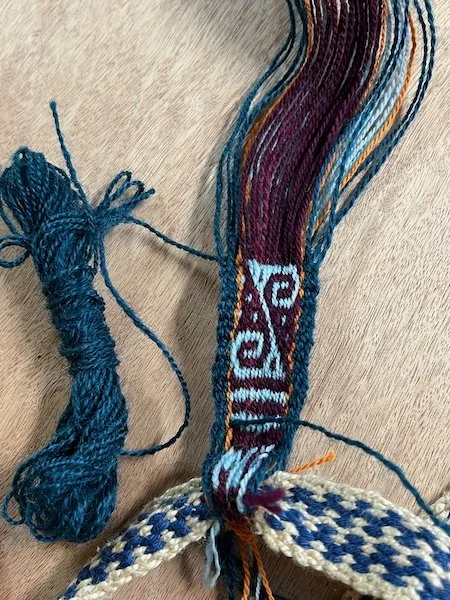
Jakaku sisan, woven with spindle-spun wool. This band began without reference to anything but my memory.
It’s fitting that I’m working this way as I learn and memorize Persian poems, as I reiterate those of Rilke I know from memory, finding the ‘king lines’ in both and carrying them with me. (The shah beyt, the ‘king line’, is the part of a Persian poem that resonates, that carries the most compelling message, worthy of memorization and repetition like a mantra.) The jakaku sisan pattern has its own shah beyt for me, a point at which the numbers (of light and dark pattern threads) balance perfectly, in a mirrored sequence, like a hinge where the movement rotates and radiates. It’s not an actual rotation point of the design, what is known as an “eye” (ñawi), but it speaks to me of the spiral intertwinement of the curls, the balanced reciprocity of color, woven thread structure, and cosmological patterns. In short, it feels like the secret of the universe is in this pattern, which makes weaving it feel like devotion, and learning its language by heart an essential participation in the reciprocity of all things.
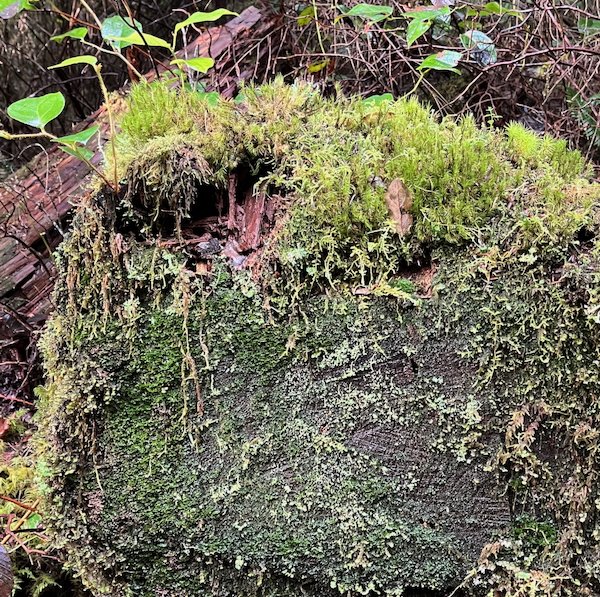
More stump life, from Quinault Rainforest on the Olympic Peninsula.